
Where SEORJ Releases Go
Southeastern Ohio Regional Jail records several kinds of departures. A person may leave for the community after bond, a court order, dismissal, or completion of a local sentence. Another person may be delivered to the Ohio Department of Rehabilitation and Correction after a felony commitment. A movement can also lead to another county jail, federal custody, or immigration custody. Each event ends SEORJ's physical possession, but only the first group is a community release. The movement record should preserve the exact release type, authority, time, and destination.
The court and jail answer different questions. A Meigs County Court or Common Pleas entry can supply legal authority, such as a bond order, sentence, dismissal, or prison commitment. It does not necessarily show when the person walked out or whether another hold blocked release. SEORJ holds the operational record of the departure. For a fuller county search and release-record request path, use the Meigs County released inmate search and reconcile both sources.
A SEORJ roster disappearance can mean release, transfer, or a data change. Obtain the movement event before describing the outcome.
Confirm a SEORJ Release
Begin with the official inmate-information page, which links to the live JDS roster. The roster is a current-custody tool. It shows a run timestamp, Jail ID, photograph, name, charges, court, current disposition, total bail, SID, booking date, attorney, next court date, and arresting agency. Those details help avoid a same-name error. They do not form a historical release list.
The captured SEORJ roster view shows how current booking and arresting-agency fields appear in the official-linked system.
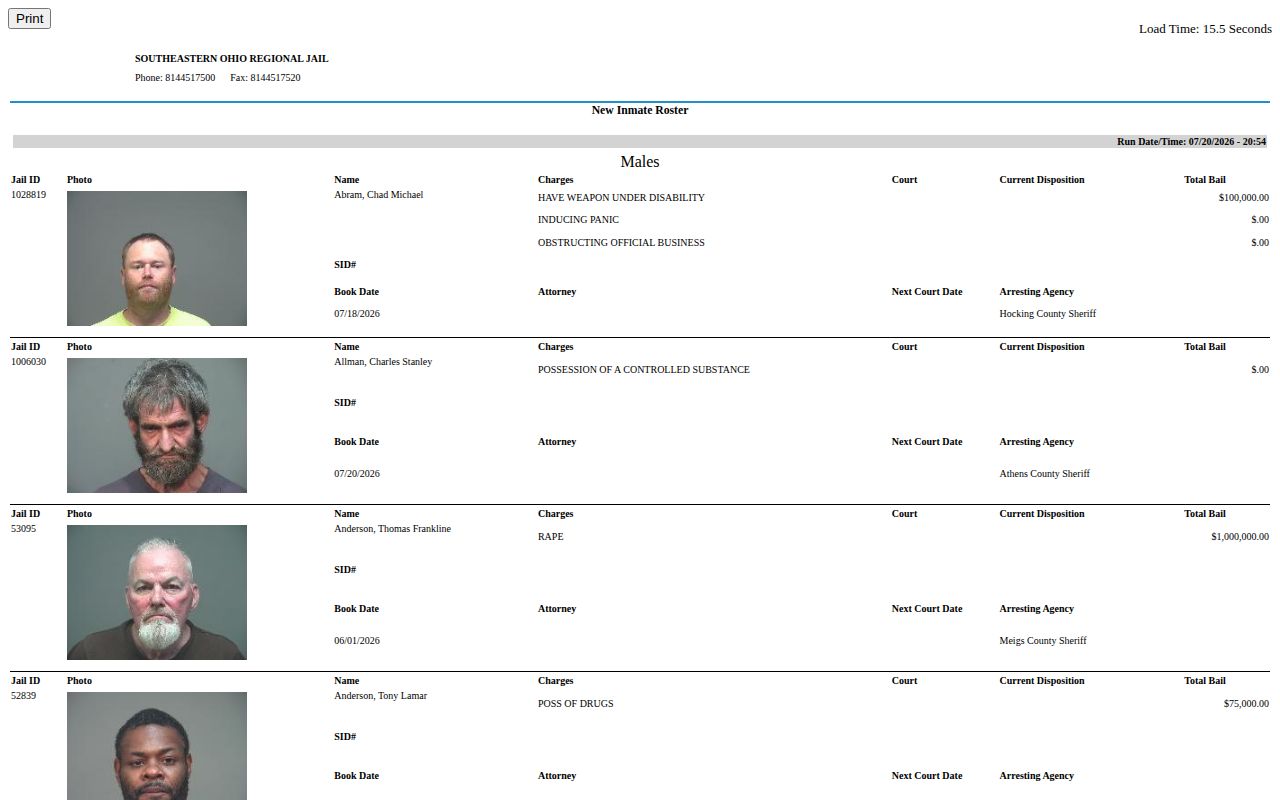
Its visible detail helps identify a booking, while the absence of a released tab confirms why a separate movement record is needed.
- Check the roster timestamp, then match the full name, Jail ID, booking date, court, and arresting agency.
- If the name is absent, call SEORJ and ask for the specific booking's release or movement event.
- Request the actual out time, release type or authority, and receiving agency when a transfer occurred.
- Match the event to the relevant Meigs County Court or Common Pleas docket.
- If the record shows an ODRC transfer, continue with the statewide offender search rather than calling it community release.
A charge row marked “Court Ordered Release” or “Dismissed” needs care. Other charge rows, warrants, or holds can keep a person detained. Read the person-level movement record, not one isolated charge line. VINE may supply a timely custody event, but the reporting facility and court record remain the stronger sources for a durable confirmation.
Identity matching matters just as much as status. A name can belong to more than one person, and a current roster is not organized as a lasting case history. Compare the Jail ID, SID, booking date, court, charge, and arresting agency before asking about the event. Give SEORJ only the identifiers needed to locate the booking. When a Meigs docket is involved, record its case number and date so the jail transaction can be compared with the correct court order. This extra check prevents a movement for one booking from being attached to another person or case.
Note: A current roster establishes present listed custody; it cannot establish what happened after a past booking disappeared.
SEORJ Release Records Contact
Direct the operational release request to Southeastern Ohio Regional Jail. No separate official SEORJ release-record form or published fee schedule was found in the reviewed material. A narrow request is easier to identify: give the person's full legal name, Jail ID or date of birth when known, and the approximate booking date. Ask for the booking and release date and time, exact release disposition, authority, and transfer destination if public.
Southeastern Ohio Regional Jail
16677 Riverside Drive
Nelsonville, OH 45764
Receptionist: (740) 753-4060
Booking fax: (740) 753-4061
Administrative fax: (740) 753-2644
Ask for records in the format already kept. Ohio public-records law generally concerns existing records, so the custodian may not have to create a custom report. If a field is withheld or redacted, ask which legal provision applies. Medical, juvenile, victim, protected-address, security, sealed, and confidential law-enforcement material can receive different treatment from basic administrative release fields.
SEORJ Regional Jail Role
Southeastern Ohio Regional Jail is a regional county jail in Nelsonville. Its official site describes an institution created and managed by Athens, Hocking, Morgan, Perry, and Vinton Counties. Meigs County is not on that collaboration list. That point matters because the jail must not be described as Meigs County's own jail or as a regional partnership member on Meigs County's behalf.
The official SEORJ facility page provides the regional identity and county-partnership context shown below.
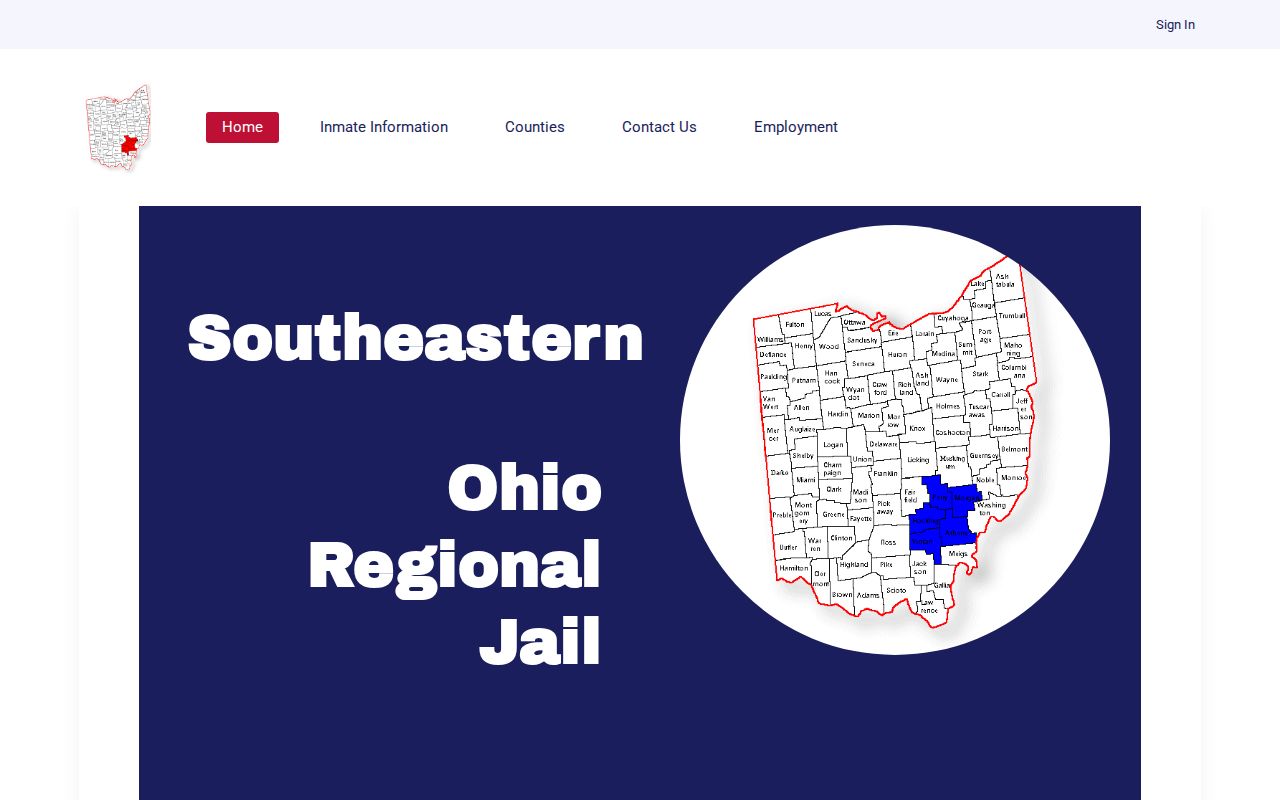
This source supports the five-county description, but it does not erase the separate roster evidence of some Meigs Sheriff arrests.
Still, the live roster observed for the Meigs research displayed bookings with “Meigs County Sheriff” as the arresting agency. The supported statement is narrow: SEORJ has held at least some people arrested by the Meigs County Sheriff. It does not follow that every Meigs detainee goes there, that the arrangement is exclusive, or that each future arrest will appear there. Call the sheriff or inspect the arresting-agency field when the actual custody location is uncertain.
- Current roster
- A live list of people the system presently reports in custody, not a release archive.
- Movement record
- The facility record showing a departure, its time, its type, and a destination when recorded.
- Transfer
- A change from one custodian to another. It is not a community release.
- Detainer
- A hold or request from another authority that may prevent physical release in one case.
Meigs Arrests on SEORJ Records
The mismatch between SEORJ's five-county partnership list and Meigs Sheriff entries on its roster is a distinctive search clue. When looking for a Meigs-origin case, inspect the “Arresting Agency” field. That field can link the regional booking to the Meigs County Sheriff even though Meigs is not named as an SEORJ member. The court field and booking date offer more cross-checks.
Do not reverse the inference. A person listed at SEORJ is not necessarily tied to Meigs, and a person arrested in Meigs is not necessarily at SEORJ. The roster serves five stated member counties and may reflect other case-specific placements. Confirm the custody site for the named booking before drawing a broader conclusion.
| Roster field | How it helps | Limit |
|---|---|---|
| Run timestamp | Dates the roster view | Does not promise an update schedule |
| Arresting agency | Can identify a Meigs Sheriff origin | Does not establish county membership |
| Current disposition | Provides charge-level context | A blank or isolated entry is not release proof |
| Court and next date | Points toward the controlling docket | Does not supply the physical exit time |
SEORJ Has No Release Feed
No official 24-hour or 72-hour released view, retention statement, or mobile jail app was located for SEORJ. Its official-linked roster embeds booking photos and carries rich current fields, but it remains a snapshot of people listed in custody. A name that appeared yesterday and is absent today could reflect release, transfer, correction, or another administrative change.
For a recent event, note the roster run time, contact SEORJ, and check the matching court docket. For an older event, request the movement or release record for the exact booking episode. A historical booking photo should also come from the responsible custodian. The roster photograph does not show that the person was later released, and it never proves the outcome of a charge.
Note: No sourced release cadence or web-retention period exists, so preserve the displayed timestamp and verify each event directly.
Follow a SEORJ Transfer
The destination determines the next search. An ODRC commitment moves the case into the statewide prison system, where the ODRC detail can later show incarceration, release, judicial release, or Adult Parole Authority supervision. A transfer to another county or regional jail makes that receiving jail the source for current custody and later release. Federal and immigration movements need their own official systems.
| SEORJ event | Next source | What to confirm |
|---|---|---|
| Community release | SEORJ record and court docket | Out time, authority, and cleared holds |
| ODRC transfer | ODRC Offender Search | Admission, institution, status, and later release detail |
| Another jail | Receiving facility | Current custody and its eventual movement |
| Federal transfer | BOP or federal case court | Federal custody scope and release status |
| ICE transfer | ICE detainee locator or contact | Present detention, not assumed community release |
The former Meigs County Jail record page explains why identifying the actual custody site is essential. The closed Pomeroy building has no current release stream, while SEORJ supplies the active regional event only for people actually held there.
Match SEORJ Release Court Records
A Meigs-origin booking may require two court searches. Meigs County Court handles misdemeanors through disposition and the bond or preliminary stage of a felony. Common Pleas handles felony indictment, judgment, prison commitment, and judicial release. A felony matter can therefore appear in both systems. Compare the case number, party name, charge, booking date, and order date instead of assuming the first docket contains the final outcome.
The sequence of entries matters. A bond-setting entry describes terms, while a receipt or later release entry can show that those terms were carried out. A sentencing entry may award jail-time credit, and a commitment order can explain a departure to ODRC. A judicial-release entry concerns a later prison exit, not the original SEORJ booking unless the records make that link. For older Common Pleas matters, the online portal says pre-January 1996 files require a Clerk visit.
Keep the jail event beside the legal authority. SEORJ can document when its custody ended and where the person went. The court can document why. Neither source should be made to answer the other source's question.