
No Meigs County 72-Hour Feed
The Meigs County Sheriff does not publish an official list of people released during a rolling 72-hour period. Its jail information page points to a “Current Inmate List.” That label matters. It is a snapshot of people represented as in custody, not an archive from which a three-day release history can be read. The page supplies no released tab, guaranteed refresh cycle, or web-retention period. No official Meigs Sheriff mobile app was located either.
Southeastern Ohio Regional Jail also offers a current roster rather than a released-person view. Some entries observed in that system name Meigs County Sheriff as arresting agency, though Meigs is not one of SEORJ's listed member counties. The regional roster is therefore a useful location check in the right case. It is not a countywide Meigs County release list, and no name should be assigned a release date merely because it no longer appears.
The official sheriff gateway shown below supports a current-custody check only.

Its lack of a 72-hour option is why a dated records request and court comparison form the reliable local method.
Build a Meigs Three-Day Range
Define the period before contacting any office. “The last 72 hours” changes each minute, while “Monday at noon through Thursday at noon” gives a records custodian fixed boundaries. Identify the holding facility as well. The former Meigs County Jail permanently closed, and a Meigs arrest can involve another custodian. The sheriff can identify the placement; SEORJ should address its own release or transfer event.
- Write down exact start and end timestamps for the three-day window, including the local time zone.
- Check the sheriff and SEORJ current roster only to locate a person who may still be held.
- Search County Court for misdemeanor dispositions and felony bond stages entered within the range.
- Search Common Pleas eServices for felony commitment, judicial release, sentence, or other controlling entries.
- Review Ohio VINE events and request the facility's existing release report or underlying transactions for the exact period.
The court and facility answer different questions. A docket may show that a judge authorized release, but the holding facility records when custody ended and whether another agency received the person. For only the current day, the Meigs County releases from the last 24 hours method narrows the request.
Meigs County Three-Day Release Fields
No public 72-hour field set exists, so distinguish fields available on the current SEORJ roster from fields that must come from an underlying release record. The roster can help match the right booking. Its run timestamp is evidence of that one generated view. It does not state how often later views will appear or how long records stay online.
| Field | Role in a 72-hour check |
|---|---|
| Run date and time | Dates the roster snapshot, without promising a future update cadence. |
| Jail ID, SID, and book date | Identify the correct custody episode across several days. |
| Name and photograph | Aid identity matching, but do not establish case outcome or release. |
| Court and arresting agency | Route a Meigs-origin case to the right docket and records custodian. |
| Release timestamp | Places the facility exit inside or outside the requested range. |
| Type and destination | Distinguish community release from a transfer or another custodial move. |
Charges, bail, attorney, next court date, and current disposition can help explain the open case. None substitutes for the out transaction. A bond amount alone does not show that bond was posted or that all holds cleared. Likewise, charge-level “dismissed” text does not prove person-level discharge when other charge rows remain active.
Note: Match the Jail ID, docket, and event time so two people with the same name are not combined into one release record.
Meigs Weekend Release Checks
A 72-hour inquiry is useful when the period crosses office closures or several court days, but no Meigs-specific weekend or holiday release rule was found. Do not claim that SEORJ releases people at a set hour or that a court entry will appear on the same day as the physical exit. The range is an organizing tool, not an official schedule.
Search dockets chronologically. County Court handles misdemeanors through disposition and the early bond stage of felonies. Common Pleas carries the later felony judgment, prison commitment, and judicial-release record. An event near the edge of the range may require checking the next docket update and asking the facility for the underlying timestamp. Pre-January 1996 Common Pleas records require contact with the clerk rather than an online-only search.
VINE may send a custody-change alert when a participating agency reports it. That event can be timely, but it is still agency-supplied and may coexist with transfer, supervision, or another hold. Preserve the reporting agency and event time, then compare them with the facility transaction.
Request Meigs 72-Hour Records
Ask the custodian for an existing jail-management release report covering the precise three-day interval. If no compiled report is kept, request the underlying release or transfer transactions within those timestamps. Ohio public-records law generally requires production of existing responsive records, not creation of a new customized list. Electronic format can reduce cost and preserve the fields as maintained.
The Meigs Sheriff records route accepts requests by email, fax, mail, or in person and provides a fillable form. Describe the period, the type of records, and any known booking identifiers. Ask for release date and time, exact disposition, releasing authority, and destination or receiving agency if recorded and public. When SEORJ housed the person, send the operational part to the SEORJ contact office.
ODRC serves a different population. Use its offender search when a Meigs felony resulted in state-prison custody, judicial release, or APA supervision. A county bond or time-served event may never appear there. For one named person across a longer period, the full Meigs County released-inmate search path reconciles county, state, federal, and notification sources.
Meigs Release Roster Limits
Meigs County's official products are present-custody paths. They are not rolling release feeds. SEORJ displays a roster generation timestamp plus Jail ID, photograph, name, charges, court, disposition, bail, SID, booking date, attorney, next court date, and arresting agency. Those rich fields can make a roster look historical even though no 24-hour or 72-hour archive is offered.
The SEORJ roster view below shows why the arresting-agency field is useful for finding a possible Meigs County placement.
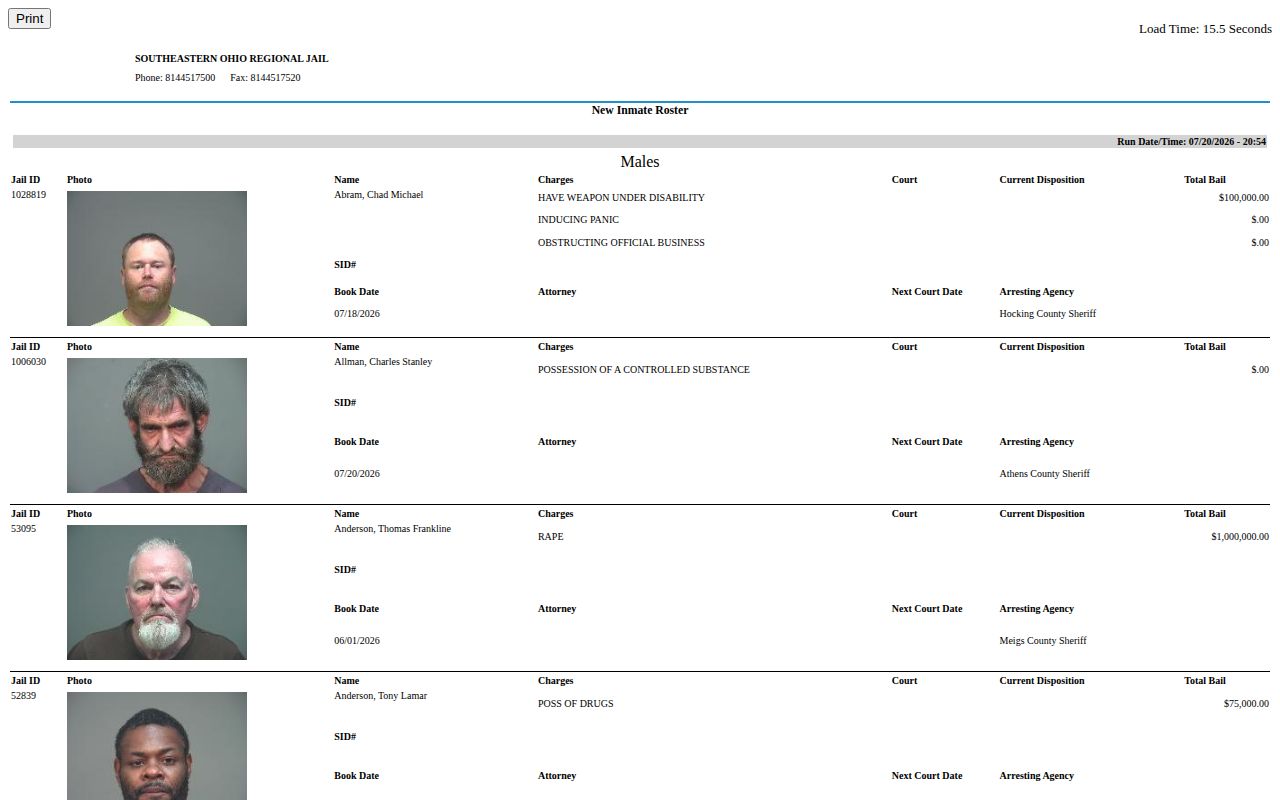
The same display also shows the limitation. It identifies people represented as currently held and provides no release-date column or historical window.
Do not create a release list by comparing saved copies. A disappeared name might reflect transfer, release, correction, or a data change. The exact movement label must survive into the final account. “Transferred to ODRC” means the first facility's custody ended, but it does not mean the person entered the community.
Note: Check the roster's printed run time, then obtain a later custodian response before describing any event within the three-day range.
Read Meigs Release Outcomes
Bond or recognizance supplies legal terms for pretrial release. It does not prove payment, acceptance, or clearance of every hold. A dismissal resolves the identified charge but may leave another case in force. Time served should be matched with the sentencing entry and jail-time credit. Each outcome needs the facility's actual exit record before it enters a Meigs County three-day count.
- Release
- The recorded end of one custodian's control, which may be to the community or another authority.
- Transfer
- A move to ODRC, another jail, federal custody, or ICE rather than community release.
- Judicial release
- A Common Pleas order allowing prison departure, often with community control and an ODRC released status.
- Detainer
- A hold from another authority that may prevent physical exit despite action in the first case.
For state cases, ODRC can show an exact Released or APA Supervision status and release detail after prison custody. For federal cases, BOP status applies only to federal custody. VINE reports a participating source's event. Keeping those scopes separate prevents a three-day local request from becoming a false claim about all custody systems.